





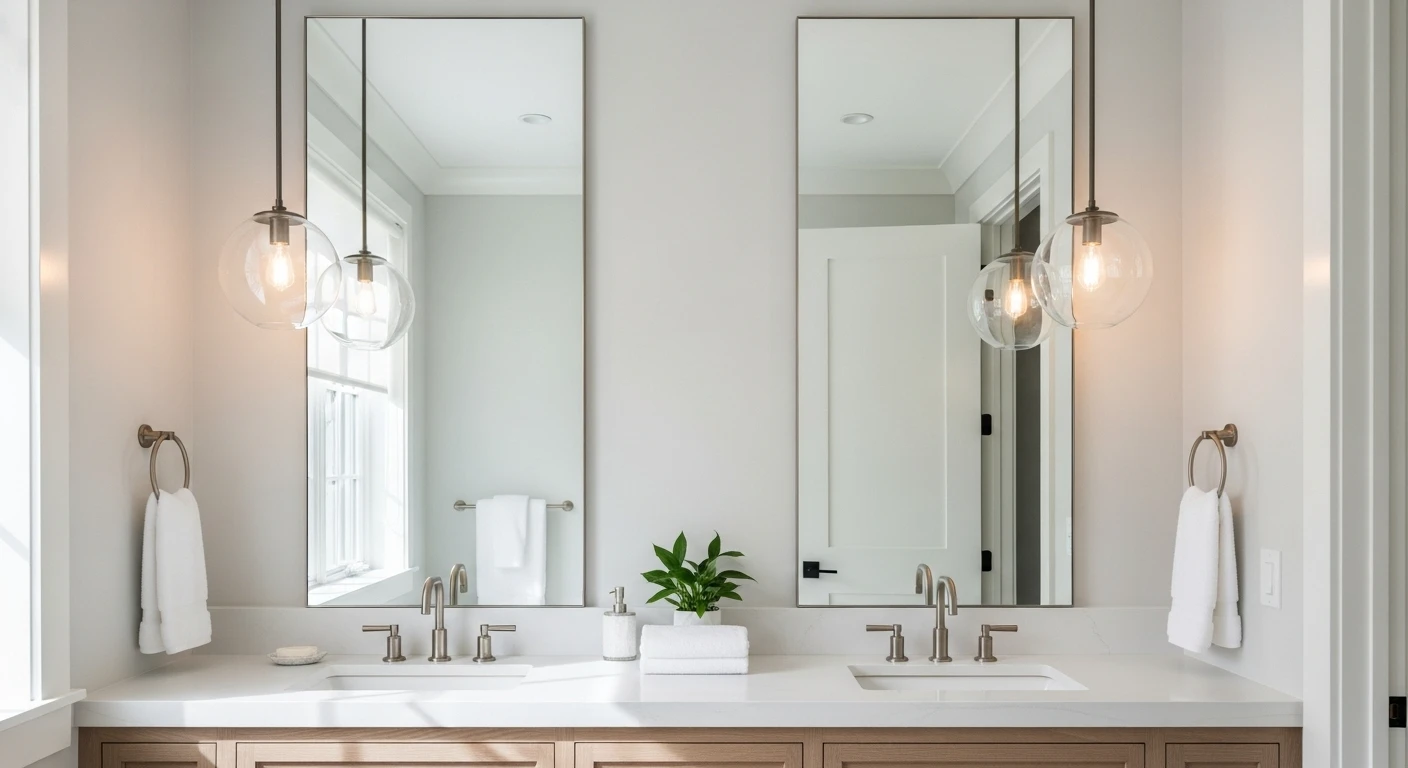

For years, every bathroom I did got a vanity bar. You know the ones. The big strip of ‘Hollywood’ bulbs over the mirror. We’d slap it on the wall, wire it up, and that was that. It worked. But it was never anything special. Now everything’s different. Every client wants a personal sanctuary. I think they get that from TV.
So the biggest thing now is pendant lighting. Hanging lights. And I’ll admit, swapping that old light bar for a couple of nice pendants can completely change how a room feels. But it’s not as easy as it looks. You can’t just go buy a pretty light and stick it on the ceiling. There are rules. About the size, the style, and more importantly, about safety. This is a wet room we’re talking about.
It’s a balancing act. Has to look good, but it also has to give you enough light to see what you’re doing. And it has to be built to handle steam from the shower every single day.
Get it right, and it makes the whole job look high-end. Get it wrong, and well, it just looks wrong. A costly mistake. Anyway, someone asked me to explain the different styles I’m putting in these days and, more importantly, the real-world rules for hanging them so you don’t screw it up.
Embrace Simplicity with Modern Minimalist Pendants
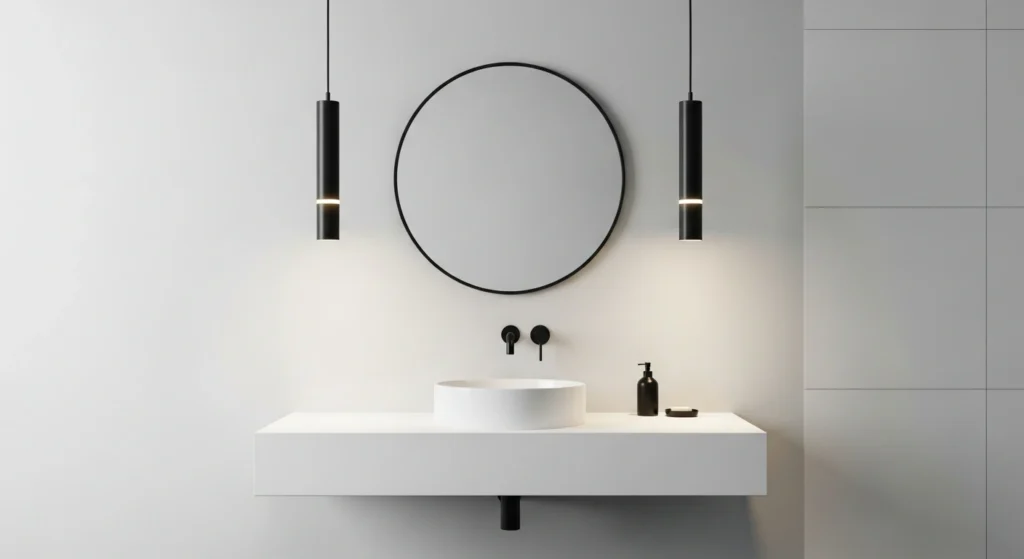
This modern look is everywhere now. It’s all about less is more, or so they tell me. Just clean lines. Simple shapes.
We’re talking about plain cylinders, or a simple glass globe, maybe even just an exposed bulb on a nice-looking cord. The reason it’s so popular is that it works almost anywhere. A pair of matte black pendants in an all-white bathroom? Looks sharp. Or you can get them in brushed nickel to match all the faucets. Easy. They work especially well in smaller bathrooms, those little powder rooms where some giant, fancy fixture would just feel… loud.
Here’s the catch with simple, though. When there’s not much to look at, you really notice the quality. A cheap one just looks cheap. The finish will be thin, you’ll see the seams. A well-made one feels solid. Intentional. I always push for frosted or opal glass because it spreads the light out. You don’t get those harsh shadows under your eyes when you’re looking in the mirror. That’s a big deal.
For the bulb, just get a warm white LED. Something around 3000K usually feels right. It’s bright enough to see but not so bright it feels like a laboratory. It’s a good look. Proves you don’t need a lot of frills to get it right.
Add Warmth with Natural and Sustainable Materials
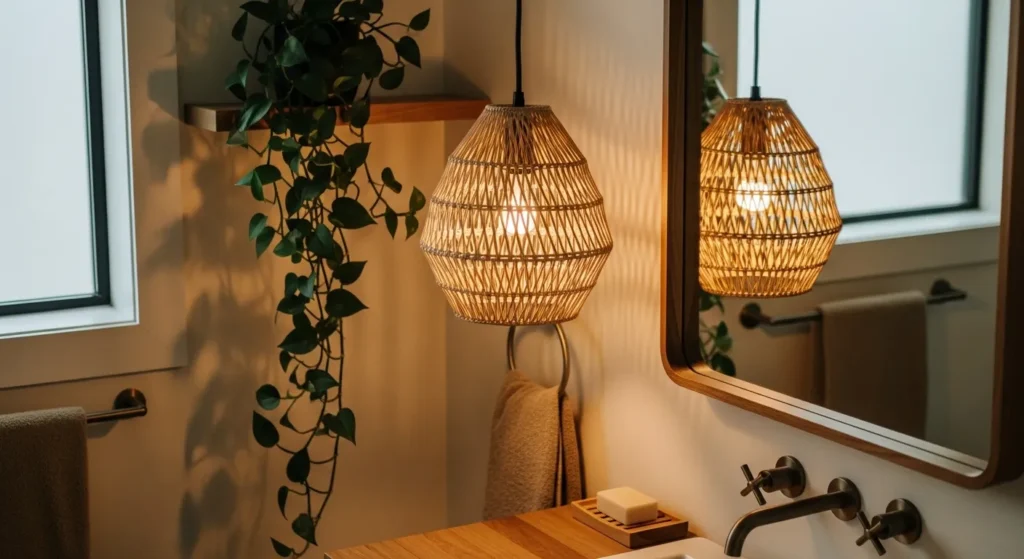
Then you have the people going in the complete opposite direction. They’re sick of all the hard, cold tile and porcelain. They want warmth. Texture.
So I’m getting more and more requests for lights made out of rattan, woven grass, sometimes even carved wood. These things can make a bathroom feel less like a bathroom and more like a spa, I suppose. A wood pendant can look great next to a wood vanity, and those woven shades make cool patterns on the wall.
But. This is where the contractor in me starts yelling.
A bathroom is a steam box. I had this client, Jenny, over on Oakwood Drive a few years back. She fell in love with this delicate, gorgeous paper lamp she found online. Insisted on it. I had to sit her down and tell her, This will be a warped, moldy mess in less than a year. You can’t just put any material in a bathroom. Whatever you choose, it `must` say damp-rated on the box. It’s not a suggestion.
That means the wiring is sealed and the materials are treated to handle moisture. For wood, it has to be sealed properly. For those woven shades, a lot of the good ones are secretly made of a synthetic material that just looks natural. And you’d better have a powerful exhaust fan. A really good one. Don’t cheap out on the fan. Ever.
Make a Statement with Oversized and Sculptural Pendants
Sometimes the goal isn’t just light. It’s drama. The wow moment. That’s when we start talking about the big, sculptural lights.
Instead of two little pendants over the sinks, maybe it’s one huge, artistic fixture right in the middle of the room. I’ve done a few of these over big freestanding tubs, too. Becomes the focal point of the whole space. It’s like hanging a piece of art that just happens to light up. They’re the jewelry of the room, as one designer told me. Okay.
From a practical side, though, big lights come with big rules.
First, you need height. Don’t even think about this in a room with a standard eight-foot ceiling. It’ll hang down so low you’ll feel like the ceiling is falling on you. You need space for a big fixture to breathe.
Second, and this is the one I don’t bend on, is the weight. Some of these things are incredibly heavy. Solid metal, huge chunks of glass. The standard electrical box in your ceiling is only rated to hold about 50 pounds. That’s it. For anything heavier, that box `must` be taken out and replaced with a heavy-duty, fan-rated box that’s braced directly to the ceiling joists. This is not a suggestion. You can’t skip this. It’s the difference between a beautiful light and a 70-pound glass object crashing into your tub. A bit more work up front, sure, but it’s absolutely necessary.
Channel Elegance with Vintage and Art Deco Styles
Everything comes back in style eventually. Right now, it’s vintage and Art Deco. Lots of geometric patterns, brass and bronze, fancy glass with ridges or fluting. That classic milk glass look.
An Art Deco light can give a bathroom some personality, keep it from looking like every other new-build on the street. It works really well with the classic stuff—subway tile, marble, hex floors. The warmth from a brass fixture just makes a room feel more inviting.
You’ve got two options here. The easy way is to buy a new fixture that’s made to look old. It comes out of the box ready to go, it’s already damp-rated and meets all the modern safety codes. Simple.
The harder, but sometimes more rewarding, way is to find a true vintage light from an antique store or salvage yard. They have real character. But I tell every single client the same thing: if you buy an actual old light, it `must` be completely rewired by a professional before I’ll touch it. The wiring in an old lamp is usually garbage. It’s brittle, the insulation is shot. Putting that in a steamy room is just asking for a fire. It costs a bit to get it rewired, but it’s a small price to pay to make sure a unique piece is also a safe piece.
How to Choose the Perfect Size and Placement for Bathroom Pendant Lighting
This is where people get it wrong. It’s the details. You can buy the most expensive light fixture in the store, but if you hang it in the wrong spot or it’s the wrong size, the whole thing looks off. I’ve been doing this since ’98. I’ve seen enough mistakes to have a few rules that just work.
Sizing Your Pendants Correctly
The light needs to be in proportion to the vanity. It’s a common mistake. People either pick tiny pendants that look lost over a big counter, or huge ones that just dominate the space.
So here’s a rule of thumb. For a standard single vanity, you know, 24 to 36 inches wide, look for a pair of pendants that are about 5 to 8 inches in diameter. If you’ve got a big double vanity, 60 or 72 inches, you can go bigger. Something in the 8 to 10-inch range for each light. You just want it to feel balanced. Substantial. Not like it’s screaming for attention or disappearing into the background.
Perfecting Placement and Height
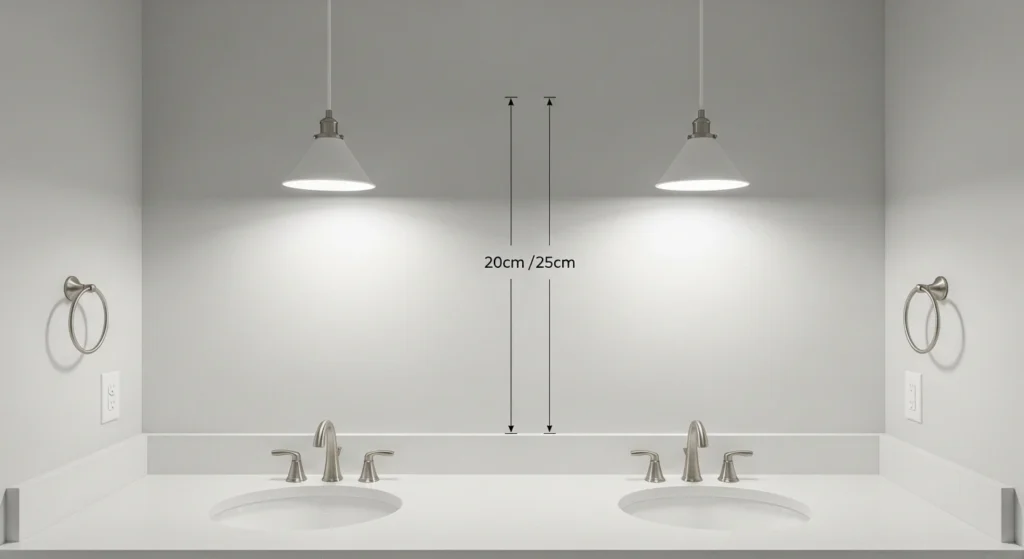
Where you hang it is everything. Both for how it looks and how it works. On a double vanity, the pendant should be centered right over the sink drain. Don’t guess. Use a tape measure. As for spacing, you want them about 30 to 36 inches apart, measuring from the center of each light. That gives each person their own zone.
The height is the most important measurement, though.
You want the bottom of the light fixture to hang somewhere between 30 and 36 inches above the countertop. That height puts the bulb just above your eye level. It lights up your face evenly, no weird shadows. It also keeps the light from being right in your face when you’re trying to use the mirror. Before my electrician, Bob, makes the final cut on the wire, I always have the homeowner come stand at the sink. Ask them, How does this feel? Because once that wire is cut, it’s cut.
I get asked the same things on almost every job. So here are the short answers.
So there you have it. It’s a nice upgrade, makes a bathroom feel a little more custom. But you have to do your homework. Pay attention to the size, the height, and please, make sure it’s rated for a bathroom. If you get those things right, you’ll be fine.