





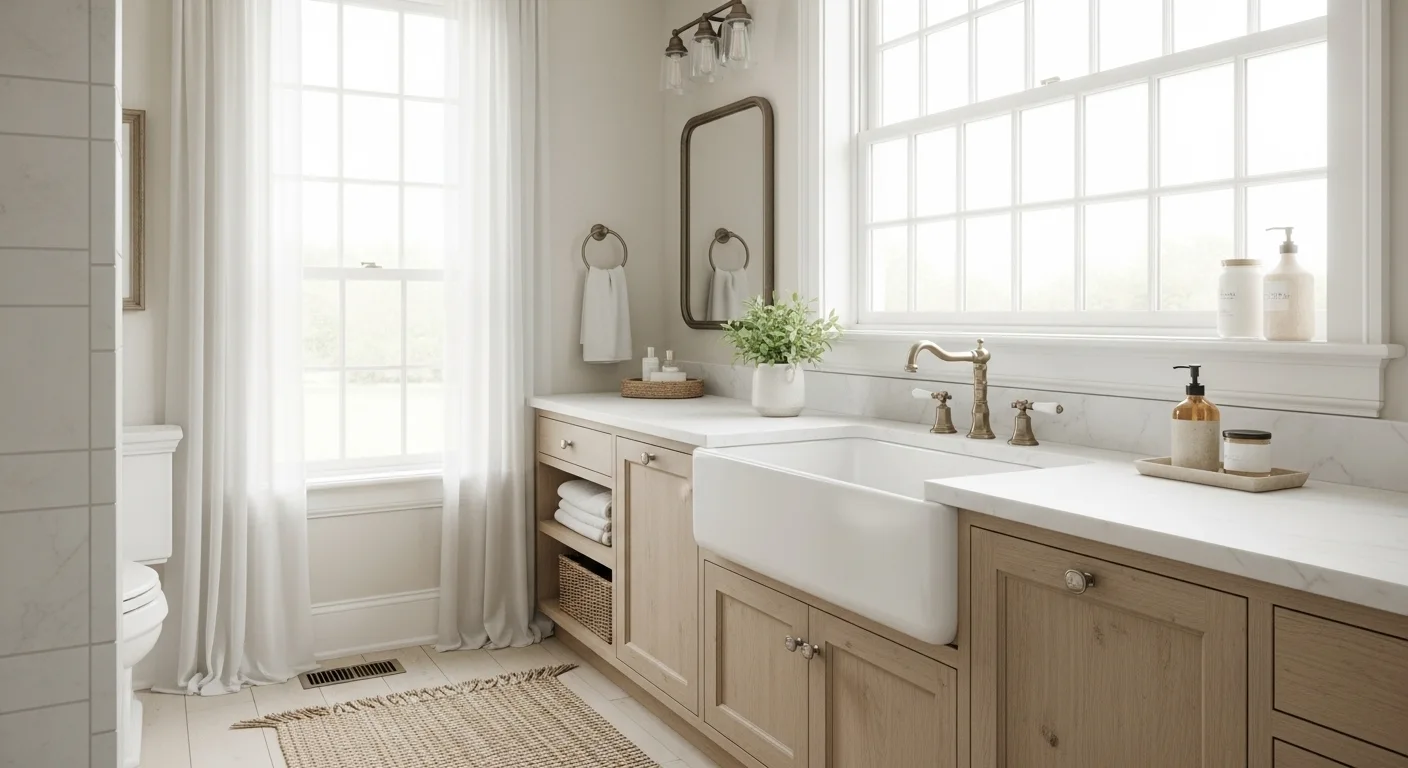

When homeowners consider a bathroom update that blends classic charm with essential practicality, the farmhouse bathroom sinks invariably emerges as a strong contender. It’s a design element rooted in history, yet it adapts beautifully to modern, eclectic, or purely traditional spaces. In my decades of renovating bathrooms, I’ve seen firsthand how a well-chosen farmhouse sink dramatically transforms a room. It’s not just about aesthetics; it’s about durability, ease of use, and seamless integration into daily life. Let’s explore how to make the optimal choices for your home.
- Choosing the Right Farmhouse Bathroom Sink for Your Space
- Exploring Popular Farmhouse Bathroom Sink Styles: Apron-Front, Pedestal, and Wall-Mounted
- Durable Materials and Finishes for Your Farmhouse Bathroom Sink
- A Contractor’s Guide to Installing Farmhouse Bathroom Sinks
- Styling Your Space: Pairing a Farmhouse Bathroom Sink with Your Vanity
- Conclusion
Choosing the Right Farmhouse Bathroom Sink for Your Space
Selecting the perfect farmhouse bathroom sink involves more than just visual appeal; you must carefully assess your bathroom’s size, its existing layout, and how much daily use it will receive. A common pitfall I’ve observed is homeowners choosing an oversized apron-front sink for a small powder room, only for it to completely overwhelm the space. This highlights the critical need to match the sink to its environment.
Consider your existing vanity, or if you’re planning a new one, visualize the sink’s dimensions relative to the overall room footprint. For smaller bathrooms, bulky sinks are usually impractical; streamlined pedestal or wall-mounted options offer distinctive style without consuming precious counter space, fostering an open feel. For spacious master bathrooms, a grander apron-front model, perhaps even a double basin, can be easily accommodated.
Beyond size, reflect on your daily sink usage. Do you need a wide basin for specific tasks, or a standard depth for routine grooming? While kitchen farmhouse sinks are known for extreme depth, bathroom versions offer varied depths suitable for personal routines.
| Bathroom Size / Usage | Recommended Farmhouse Sink Style | Key Benefit | Considerations |
|---|---|---|---|
| Small bathrooms / Powder rooms | Pedestal or Wall-Mounted | Maximizes floor space, open feel | Limited or no enclosed storage; wall reinforcement for wall-mounted |
| Spacious Master bathrooms | Apron-Front (single or double) | Grand visual statement, ample basin space | Requires robust vanity/support; significant footprint |
| General daily use | Standard depth basin | Suitable for routine grooming | |
| Specific tasks | Wide basin | Accommodates specific activities (e.g., handwashing large items) |
Are farmhouse sinks practical for bathrooms? Absolutely, if selected thoughtfully. They typically provide ample basin space, a distinct advantage over many smaller, purely decorative options, making them a practical choice when balancing classic character with dependable everyday functionality.
Exploring Popular Farmhouse Bathroom Sink Styles: Apron-Front, Pedestal, and Wall-Mounted
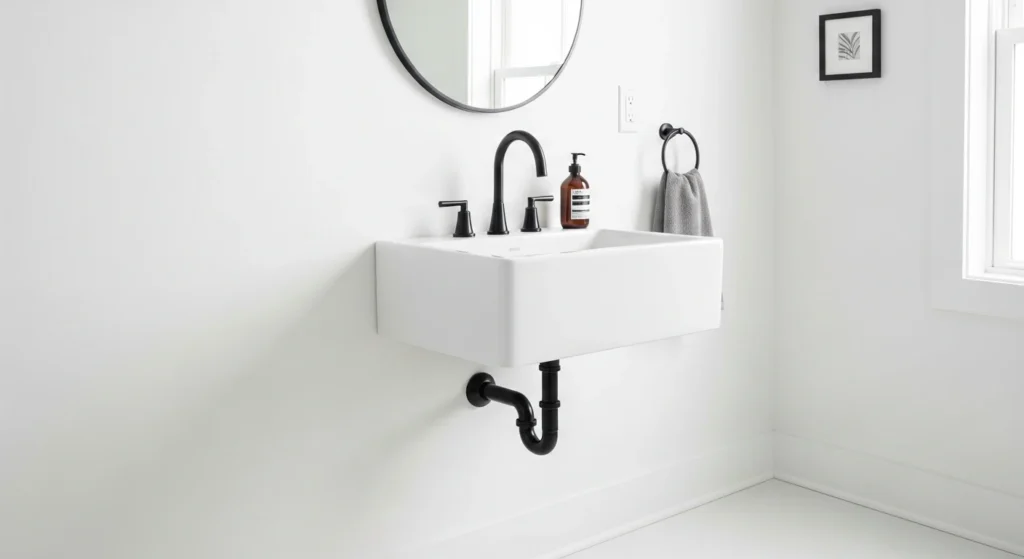
When the term “farmhouse sink” is mentioned, most people envision the apron-front style, but the category encompasses a broader range, each offering unique visual impact and practical renovation considerations. The classic apron-front farmhouse bathroom sink, with its characteristic exposed front panel extending beyond the vanity, makes a significant visual statement.
These models tend to be larger, often necessitating a custom-built vanity or substantial modifications to an existing one. Available in single or double basin configurations, their considerable weight and dimensions demand robust under-counter support. Homeowners love their visual impact, but often underestimate the underlying structural work needed for a truly secure installation.
For smaller bathrooms or powder rooms where a full vanity would feel cramped, an elegant pedestal farmhouse sink is an excellent choice. This style combines the iconic basin shape with a freestanding base, evoking a timeless, traditional elegance while freeing up floor space for a more open feel. The primary trade-off is the absence of enclosed storage, which many homeowners readily accept for the aesthetic gain.
Finally, for a genuinely minimalist or space-constrained bathroom, a wall-mounted farmhouse sink offers an excellent solution. These sinks attach directly to the wall, leaving the floor entirely clear, which is fantastic for maximizing perceived space. Can I put a farmhouse sink in a small bathroom? Yes, especially with these wall-mounted or pedestal styles.
However, proper wall blocking and reinforcement within the wall cavity are absolutely essential for their heavy fixtures; inadequate support means long-term structural problems. Understanding these fundamental differences is crucial for a choice you’ll be happy with for decades.
| Style | Description | Ideal For | Key Features / Considerations |
|---|---|---|---|
| Apron-Front | Exposed front panel extends beyond vanity | Spacious bathrooms, visual statement | Larger size, requires custom vanity/modifications, robust support, single/double basin options |
| Pedestal | Basin combined with freestanding base | Smaller bathrooms, powder rooms | Frees up floor space, timeless elegance, no enclosed storage |
| Wall-Mounted | Attaches directly to the wall, floor clear | Minimalist/space-constrained bathrooms | Maximizes perceived space, requires essential wall blocking/reinforcement |
Durable Materials and Finishes for Your Farmhouse Bathroom Sink

The material of your farmhouse bathroom sink profoundly affects its durability, maintenance requirements, and overall aesthetic longevity. What material is best for a farmhouse sink? There isn’t a universal answer; it truly depends on your specific priorities and budget.
| Material | Durability | Maintenance | Key Characteristics / Aesthetics | Weight / Installation | Cost (Relative) |
|---|---|---|---|---|---|
| Fireclay | High | Easy cleaning (mild soap/water), resistant to scratches, chips, staining | Hard, non-porous, classic ceramic look | Moderate | Medium-High |
| Enameled Cast Iron | Very High | Robust, but severe impact can chip enamel | Lustrous, classic finish, substantial feel | Very Heavy (requires extra support) | High |
| Natural Stone | High (with care) | Regular sealing, meticulous to prevent staining/etching | Visually stunning, unique patterns | Heavy | Very High |
| Hammered Copper | High (develops patina) | Specific cleaning regimens, develops rich patina over time | Distinctive, evolving finish, warm tones | Moderate | Very High |
Fireclay is consistently the most popular choice for farmhouse sinks, and for good reason. It’s produced by firing ceramic clay at extremely high temperatures, creating a remarkably hard, non-porous surface that is exceptionally resistant to scratches, chips, and staining. Reputable brands like Elkay and Blanco offer outstanding fireclay options proven to endure; while impressively tough, it isn’t immune to extreme impact, so careful use helps maintain its pristine condition.
Enameled cast iron sinks provide remarkable durability coupled with a lustrous, classic finish. They are incredibly dense and heavy, a factor requiring additional structural support within the vanity during installation. The enamel coating is robust, but a severe impact can cause chipping, potentially exposing the underlying iron.
Nevertheless, with diligent care, a cast iron farmhouse sink can last for generations; their substantial weight also contributes to a solid feel and superior sound dampening, a subtle benefit appreciated over time. For a truly distinctive statement, consider natural stone or hammered copper.
Stone sinks, such as those carved from granite or marble, are visually stunning but demand regular sealing and meticulous maintenance to prevent staining and etching. Copper sinks, on the other hand, develop a rich, evolving patina over time, which many find highly desirable, though it’s not for those who prefer a consistently bright finish. Both stone and copper represent a greater investment and necessitate specific cleaning regimens from day one.
A Contractor’s Guide to Installing Farmhouse Bathroom Sinks
Installation is the critical juncture were theoretical plans become reality. Ensuring your farmhouse bathroom sink is properly installed is paramount for both its immediate function and its long-term integrity. This is far from a simple drop-in fixture; apron-front models, in particular, demand precision.
Based on my numerous projects, I can confirm that cutting corners during installation invariably leads to costly and frustrating issues down the road. Do farmhouse sinks require special plumbing? Not in terms of exotic components, but they frequently demand meticulous planning for drain lines and faucet positioning. Their inherent depth and placement can necessitate adjustments to the P-trap configuration and supply line rough-ins.
More importantly, the substantial weight of many farmhouse sinks mandates robust structural support. Whether it’s a reinforced cabinet for an apron-front or sturdy wall blocking for a wall-mounted unit, ensuring adequate support is non-negotiable to prevent sagging or detachment over time. Always adhere strictly to the manufacturer’s installation guidelines.
If you’re integrating an apron-front farmhouse sink into an existing vanity, prepare for significant carpentry work. The front face of the vanity cabinet must be precisely cut to accommodate the sink’s apron, a task requiring skill, as an uneven cut will be glaringly obvious.
Furthermore, the cabinet structure beneath will need substantial reinforcement to bear the sink’s considerable weight; I recall a project where we built a custom plywood cradle inside an older vanity to perfectly support a heavy fireclay sink, ensuring ideal stability and levelness.
For pedestal and wall-mounted farmhouse sinks, the most critical installation step involves securely fastening them to the wall. This almost invariably requires opening the wall to install solid horizontal wood blocking between the studs. This provides a supremely reliable anchoring point for the sink’s mounting brackets; relying solely on drywall anchors or screws into individual studs without proper blocking is a serious risk. The objective is a rock-solid, stable fixture that won’t wobble or pull away from the wall over years of use.
Styling Your Space: Pairing a Farmhouse Bathroom Sink with Your Vanity
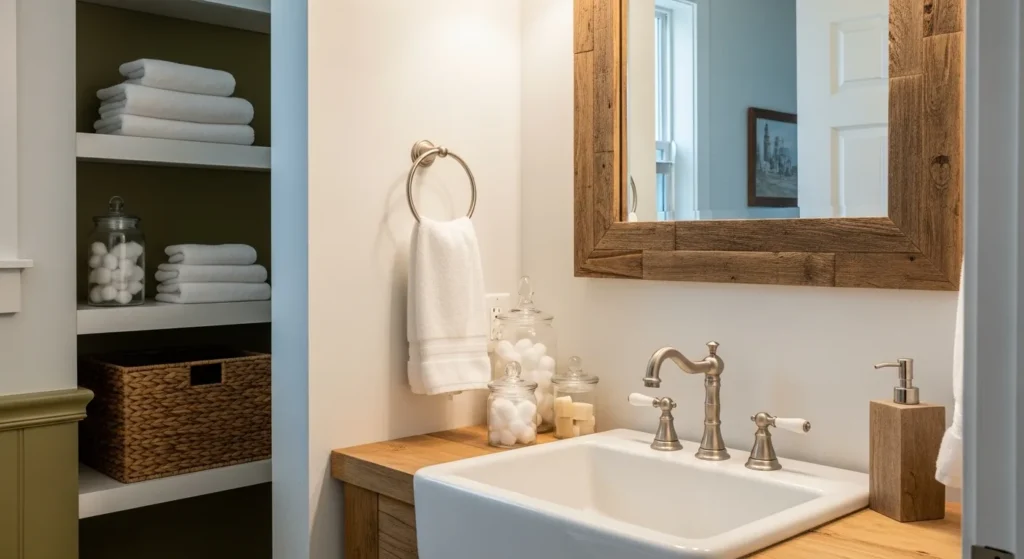
A farmhouse bathroom sink naturally serves as a powerful focal point, making the harmonious styling of surrounding elements essential for a cohesive design. The sink itself is just one part of the equation; the entire ensemble creates the desired effect. I’ve often seen beautifully chosen sinks lose their impact because the vanity, faucet, or lighting didn’t quite complement their distinctive character and style.
For an apron-front sink, a shaker-style vanity in a natural wood finish, a subtly distressed look, or a classic white or gray paint color provides an ideal foundation. Vanities featuring open shelving or slatted doors also reinforce the farmhouse aesthetic.
Pedestal and wall-mounted sinks, by design, don’t use traditional vanities, opening up possibilities for creative wall storage solutions. Consider adding reclaimed wood floating shelves or vintage-inspired wall cabinets nearby to offer functionality without detracting from the sink’s prominence.
Selecting the appropriate faucet is equally crucial for completing the look. Finishes such as oil-rubbed bronze, brushed nickel, or matte black frequently pair exceptionally well with the farmhouse style. Look for traditional bridge faucets, elegant gooseneck designs, or classic cross-handle styles; avoid overly sleek or modern chrome fixtures, which can create a jarring contrast.
For any vanity hardware, opt for cup pulls, bin pulls, or simple knob designs in a complementary finish—these seemingly minor details significantly contribute to the overall unified design.
Finally, turn your attention to lighting and accessories. Barn-style sconces, wall-mounted lanterns, or pendant lights with exposed filament bulbs can dramatically enhance the rustic charm. Mirrors framed in reclaimed wood or distressed metal are excellent choices to echo the theme. Simple, functional accessories like woven baskets for storage, clear glass jars, and soft white towels will reinforce the farmhouse vibe without introducing visual clutter. The aim is to cultivate an inviting atmosphere that feels both timeless and genuinely lived-in.
| Element | Recommendations for Farmhouse Style | Avoid |
|---|---|---|
| Vanity (Apron-Front) | Shaker-style, natural wood, distressed, white/gray paint, open shelving | Overly sleek, ultra-modern designs |
| Storage (Pedestal/Wall-Mounted) | Reclaimed wood floating shelves, vintage-inspired wall cabinets | Bulky, enclosed storage next to sink |
| Faucets | Oil-rubbed bronze, brushed nickel, matte black; bridge, gooseneck, cross-handle | Overly sleek, modern chrome fixtures |
| Hardware | Cup pulls, bin pulls, simple knobs (complementary finish) | Intricate, overly decorative, very modern |
| Lighting | Barn-style sconces, wall-mounted lanterns, exposed filament pendants | Recessed lighting, track lighting |
| Accessories | Woven baskets, clear glass jars, soft white towels | Cluttered, overly vibrant, synthetic items |
Conclusion
Choosing and installing a farmhouse bathroom sink is a truly rewarding project that significantly elevates your bathroom’s overall character and functionality. It’s a decision that thoughtfully balances aesthetic preferences with critical practical considerations. By conducting your research and planning diligently upfront, you will circumvent many potential frustrations down the line.
Always consider your specific space, your daily functional requirements, and the long-term durability of your chosen materials. With careful planning and a solid grasp of the installation nuances, you’re sure to achieve a beautiful, lasting addition to your home.
I hope these insights from my many years in the trade prove valuable for your next bathroom renovation. Please share your own experiences and any questions in the comments below; it’s always insightful to hear from others as we collectively create beautiful, functional spaces.
Are farmhouse sinks practical for bathrooms?
Yes, they are highly practical. Their generous basin size is ideal for many bathroom activities, from handwashing to children’s bath time. The key is selecting the right size and style for your bathroom’s dimensions and intended use, ensuring it enhances functionality.
Do farmhouse sinks require special plumbing?
Not in the sense of unique components, but their depth and installation method often necessitate careful adjustments to standard drain lines and P-traps. Apron-front models, especially, may require moving supply lines. Professional installation and precise planning are essential for correct alignment.
Can I put a farmhouse sink in a small bathroom?
Absolutely. While larger apron-front sinks might overwhelm, pedestal and wall-mounted farmhouse sinks are excellent for compact spaces. They deliver the distinctive aesthetic without consuming valuable counter space, making them a practical and stylish choice.
How do you maintain a farmhouse bathroom sink?
Maintenance varies by material. Fireclay and enameled cast iron generally clean easily with mild soap and water, avoiding abrasives. Natural stone requires consistent sealing. Copper will develop a patina; gentle cleaning is usually sufficient.