






When you’re deeply involved in a bathroom renovation, it’s easy to focus on major decisions like tile choices, vanity styles, or shower setups. However, I’ve observed countless homeowners overlooking seemingly minor details that significantly impact daily use. One such detail is towel bar height.
- Understanding the Standard Towel Bar Height
- Customizing Towel Bar Height for Your Specific Space and Needs
- Specific Placement Considerations: Where to Install Your Towel Bar
- Installing Multiple Towel Bars and Storage Options
- Common Towel Bar Installation Mistakes and How to Avoid Them
- Contractor’s Pro Tips for Towel Bar Installation

While it might appear trivial, an incorrectly placed towel bar can lead to daily frustration. After years of hands-on experience in fitting out bathrooms, I’ve learned that achieving the correct towel bar height isn’t just about aesthetics; it’s fundamental to functionality, comfort, and ensuring your bathroom truly meets your needs.
You want your freshly used towel to be within easy reach, without straining to grab it or bending awkwardly. Proper towel bar placement also ensures your towel dries effectively, preventing it from crumpling against the floor or bunching up. Crucially, it must not interfere with other bathroom fixtures. So, let’s explore how to master this, directly from a contractor who has executed it hundreds of times.
Understanding the Standard Towel Bar Height

Let’s begin with the fundamentals, as there’s a commonly accepted guideline that most contractors, myself included, use as an initial reference. For a standard bath towel bar, the industry rule of thumb typically places the center of the bar at approximately 48 inches (or 122 cm) from the finished floor. This measurement is generally applied to adult-oriented bathrooms and is designed to accommodate the average adult’s reach comfortably, without requiring them to stoop or stretch.
Why 48 inches? This height provides a comfortable reach for most adults to retrieve a towel after exiting the shower. It also ensures that a standard bath towel, when folded over the bar, hangs freely without touching the floor. This is vital for proper drying and hygiene.
A typical bath towel measures about 27 by 52 inches, so when draped over a bar at 48 inches, its bottom edge will be well clear of the floor. However, I always emphasize to my clients that “standard” doesn’t always equate to “perfect” for your unique situation.
It serves as a baseline, a good starting point for consideration, but rarely the definitive answer. Every bathroom and every homeowner possess distinct characteristics, and these differences are highly significant.
Customizing Towel Bar Height for Your Specific Space and Needs
This is where practical experience becomes invaluable. Adhering strictly to the 48-inch rule without considering other variables is a mistake I’ve frequently witnessed. To truly optimize your towel bar placement, you must thoughtfully consider who will be using the bathroom and how they intend to use it.
Considering the Users
Reflect on the primary users of this particular bathroom. Is it predominantly for adults of average height? Or does your household include exceptionally tall or short individuals? For instance, in a family bathroom, a bar positioned at 48 inches might be too high for younger children to comfortably reach their own hand towels.
For children, I often suggest a lower bar, possibly around 36 to 40 inches (91-102 cm), or even the use of hooks at varying heights. For a master bathroom where one partner is significantly taller, we might increase that 48-inch standard to 50-52 inches (127-132 cm) to prevent longer towels from touching the floor. The overarching goal is to simplify daily life, not complicate it.
Accessibility Standards (ADA Towel Bar Height)
If you are designing a bathroom for someone with mobility challenges or planning for aging in place, ADA (Americans with Disabilities Act) guidelines become paramount. For towel bars, the general ADA standard specifies that the bottom edge of the towel bar must be mounted between 15 inches (38 cm) and 48 inches (122 cm) from the finished floor.
This range guarantees that an individual in a wheelchair, or someone with limited reach, can comfortably access the towel.
Specifically, if the approach to the towel bar is parallel to the wall (meaning you access it from the side), the maximum height for the top of the bar is 48 inches. If the approach is forward (reaching directly over an obstruction), the maximum high forward reach is also 48 inches, meaning the bar itself should be positioned below that.
For hand towels, consider a towel ring or a smaller bar placed closer to the sink, always within that accessible reach zone. This adherence is not merely about compliance; it’s about fostering dignity and independence.
Towel Length and Type
Not all towels are created equal. You have substantial bath sheets, standard bath towels, modest hand towels, and small washcloths. The type of towel you primarily intend to use on a given bar should directly influence its towel bar height.
Bath Towels/Bath Sheets: If you prefer oversized bath sheets (which can measure 35×60 inches or larger), the standard 48-inch height might cause them to drag on the floor. In such instances, I would elevate the bar to 50 or 52 inches (127-132 cm) to ensure they hang freely and dry properly. You certainly want to avoid a damp towel collecting dust from the floor.
Hand Towels: These are typically smaller, around 16×30 inches. A dedicated hand towel bar near the sink does not need to be as high. I commonly recommend placing the center of a hand towel bar or ring around 42 to 44 inches (107-112 cm) from the floor, making it easily accessible for hand drying after washing.
Washcloths: For these, hooks are often more practical than a bar, or they can share a hand towel bar. If opting for a hook, position it at a convenient height, perhaps 40 inches (102 cm) from the floor, particularly if children will be using them.
Bathroom Size and Layout
The overall dimensions and configuration of your bathroom are also critical factors. In a small bathroom, vertical space is frequently limited. You might not have an expansive, clear wall section suitable for a long bar. In these scenarios, you could consider:
Over-the-toilet placement: More on this shortly, but towel bar height here is crucial to prevent interference with the toilet tank lid.
Back of the door: This is an excellent space-saving option, but verify that the bar height clears any door hardware or trim.
Vertical towel ladders or hooks: These can be highly efficient in confined spaces and permit varied hanging heights.
In a larger bathroom, you possess greater flexibility, but you still need to consider proximity to the shower, bathtub, and vanity. Avoid selecting a random wall; instead, choose a spot that makes functional sense. A recent project involved a very long bathroom.
We decided to place a primary towel bar near the shower, and a secondary, slightly lower bar for hand towels closer to the double vanity. The optimal solution always depends on the flow and intended use of the space.
Specific Placement Considerations: Where to Install Your Towel Bar

The towel bar height is one aspect, but its placement is equally crucial. The location dictates convenience, drying efficiency, and the overall aesthetic appeal of the bathroom.
Near the Shower or Bathtub
This represents the most common and often most logical position for a main bath towel bar. You want to be able to effortlessly reach your towel as you exit, avoiding drips across the room. I generally advise positioning the bar so it is within arm’s reach of the shower or tub exit, typically 24 to 36 inches (61-91 cm) from the edge of the shower opening.
However, remain conscious of splash zones. You don’t want your clean towel to get soaked by shower spray, especially with a curbless shower or one without a full door. In such cases, you might need to place the bar slightly further away, perhaps on an adjacent wall less prone to getting wet, or consider a heated towel rack positioned a bit further out.
We recently installed a heated towel bar in a project approximately 30 inches from the shower glass, and it proved to be perfect – warm towels, without any splashes.
Above the Toilet
Installing a towel bar over a toilet is a common solution for smaller bathrooms where wall space is at a premium. Yes, this is absolutely feasible, but it requires some critical considerations. The primary concern is clearance. You must ensure sufficient space above the toilet tank to comfortably remove and replace the lid for maintenance without striking the towel bar or the towel itself.
I typically aim for the bottom of the towel bar to be at least 18 to 24 inches (46-61 cm) above the toilet tank lid. This generally positions the center of the bar in the 50 to 54-inch (127-137 cm) range from the floor.
This specific height provides ample room and also helps prevent the towel from dangling into the toilet bowl – an absolute necessity! It also creates a less visually cramped appearance at this height.
Near the Vanity/Sink
For hand towels, a dedicated hand towel bar or ring near the vanity is ideal. This should be easily accessible after washing hands. As previously mentioned, I usually place these at a comfortable height of 42 to 44 inches (107-112 cm) from the floor to the center of the bar or ring.
Ensure it is not so close to the sink that it constantly gets splashed but still remains within comfortable reach. Occasionally, mounting a small ring on the side of the vanity cabinet itself offers an excellent solution, particularly for a powder room.
On the Back of the Door
This is another superb space-saving alternative, especially for guest bathrooms or smaller main bathrooms. Mounting a towel bar on the back of the bathroom door keeps towels out of the primary line of sight and frees up valuable wall space. When choosing this option, ensure the towel bar height allows the towel to hang freely without touching the floor when the door is closed.
Also, verify that door hardware (handle, hinges) does not obstruct the towel bar’s placement or the towel’s drape. I typically recommend placing these at the standard 48-inch height or slightly higher, depending on the door length and any lower trim.
Installing Multiple Towel Bars and Storage Options
Many bathrooms, especially master bathrooms or family bathrooms, benefit from more than one towel bar or various types of towel storage. Do not feel restricted to just one!
For Families or Guests: If multiple individuals use the bathroom, individual towel bars or a series of hooks are considerably more practical than cramming several wet towels onto a single bar. This promotes better drying and prevents that damp, musty odor.
I have often installed two standard bath towel bars side-by-side, spaced about 18-24 inches (46-61 cm) apart, or positioned one above the other in a staggered arrangement.
Mixing Storage Types: Consider a combination: a main bath towel bar, a hand towel ring near the sink, and perhaps a row of hooks for bathrobes or additional towels.
Hooks are excellent for children as they are simpler to use.
Heated Towel Racks: These offer a luxury, yet practical, solution, keeping towels dry and warm.
Their placement is typically dictated by plumbing and electrical outlet availability, but functionally, treat them like a primary bath towel bar regarding height and proximity to the shower. Ensure their height still allows towels to hang without dragging.
Common Towel Bar Installation Mistakes and How to Avoid Them
Even with the best intentions, I’ve witnessed homeowners (and even less experienced contractors) make significant errors with towel bars. Here’s how to circumvent them:
Too High or Too Low: This is the most obvious error. Too high means straining, while too low results in towels on the floor. Always test the height with a mock-up, as I’ll explain shortly.
Too Close to Obstructions: Placing a towel bar too close to a door frame, a shower glass panel, or a cabinet can cause the towel to be squished or make the bar itself difficult to access. Always leave ample clearance – at least 2-3 inches (5-7.5 cm) from any obstruction on either side.
Ignoring Wall Studs: This is a crucial aspect for long-term stability. Towel bars endure a fair amount of pulling and tugging. If they are not mounted into a wall stud, they will eventually pull out of drywall, especially when supporting a heavy bath sheet. Use a stud finder diligently.
If you cannot align with a stud, employ heavy-duty drywall anchors; toggle bolts or self-drilling anchors are vastly superior to the plastic ones often supplied with generic hardware.
Not Planning for Towel Drape: People frequently measure the bar height without considering how the towel will hang. Always visualize it. Take an actual towel, fold it over, and hold it at your proposed height to verify if it clears the floor or other fixtures.
On a recent project, a homeowner was firm on a specific towel bar height for a bar over a toilet, but when we held up her preferred bath sheets, they almost touched the water! A quick adjustment prevented a lot of future annoyance.
Rushing Placement: This process should not be rushed. Take your time, measure, re-measure, and solicit a second opinion if you’re uncertain. A properly placed towel bar will serve you effectively for years. A hurried installation will be a constant source of irritation.
Contractor’s Pro Tips for Towel Bar Installation
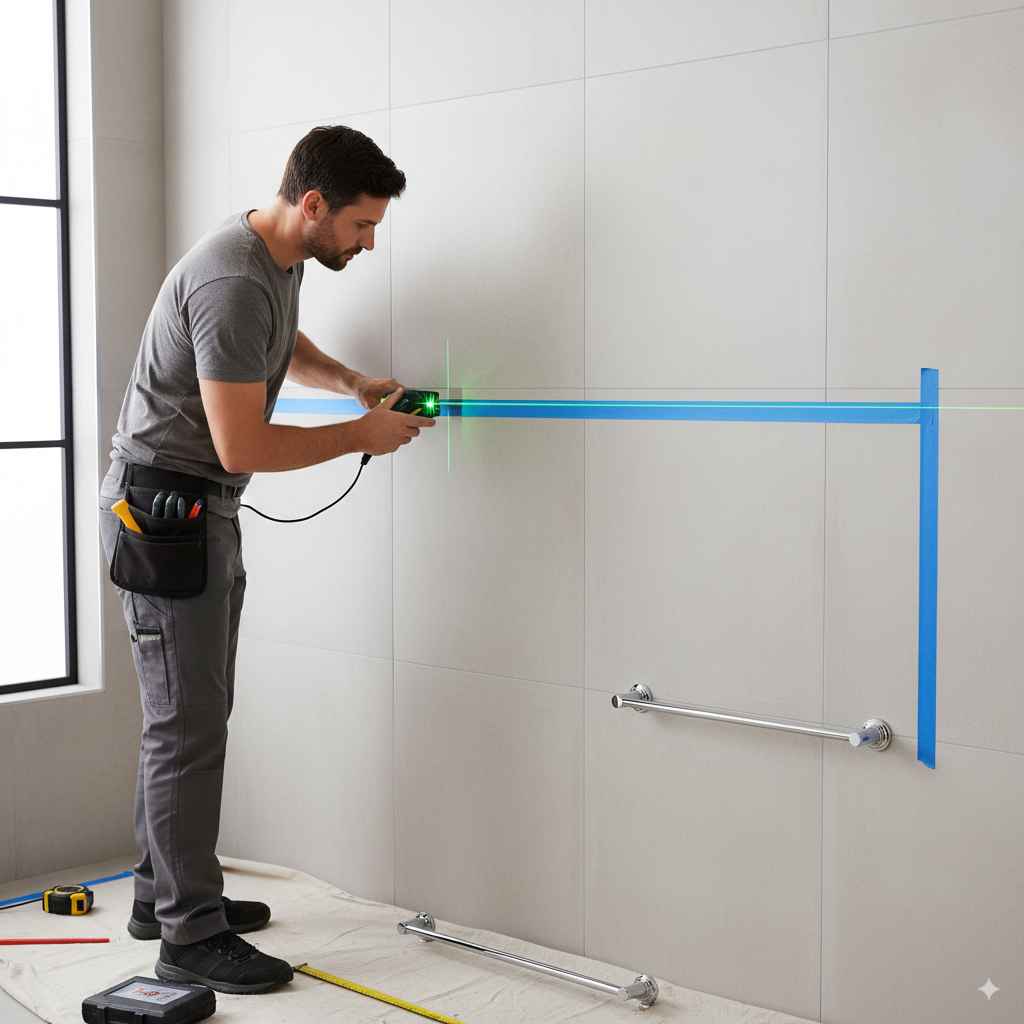
Here are some practical tips I’ve acquired over the years that will make your installation process smoother and more effective for achieving optimal towel bar height and placement:
1. Measure and Mark with Precision: Do not estimate by eye. Utilize a tape measure and a pencil. For perfect level, use a laser level or a traditional spirit level. Mark both ends of the towel bar’s mounting brackets accurately.
2. Mock it Up with Painter’s Tape: Before drilling any holes, cut pieces of painter’s tape or masking tape to the exact length of your towel bar. Adhere them to the wall at your proposed height and location. Then, drape a real towel over it. Step back, observe from various angles, and mentally walk through your daily routine. Does it feel correct? Does the towel clear everything? This visual verification is invaluable.
3. Find Those Studs: As I emphasized, a stud finder is your indispensable tool here. Mark the edges of the studs. If your towel bar screws align with a stud, that’s ideal. If not, plan for robust drywall anchors. My preference is for products like a Toggl-Bolt or a Snap toggle for maximum holding power in drywall.
4. Consider the Hardware: The specific type of towel bar you purchase is important. Some feature simple screw-in mounts, while others incorporate more robust concealed brackets. Read the instructions meticulously. Good quality hardware typically includes superior mounting solutions.
5. Clean Your Workspace: Maintain a tidy area. Use a small bag or cup beneath your drill bit to collect drywall dust if you are drilling into existing finished walls. This is a minor detail that saves significant cleanup time.
6. Don’t Over-Tighten: Once the bar is mounted, tighten the set screws (if your bar includes them) firmly, but avoid excessive force. You risk stripping the screws or cracking the mounting bracket. Just snug enough to hold it securely.